|
Welcome to Taiwan Chapter of International Academy of Engineering
|
【Invitation】Join us on the "Tang Prize Masters' Forum in Sustainable Development" on Sept. 26 |
 |
 |
 |
|
Written by Administrator
|
|
Wednesday, 14 September 2022 17:43 |

Greetings from the Tang Prize Foundation,
Accelerating climate change and global warming provide the most convincing argument that to achieve sustainable development goals brooks no delay. 2022 Tang Prize laureate in Sustainable Development Professor Jeffrey Sachs is not only a world-renowned economist but also the director of the Center for Sustainable Development at Columbia University and the president of the UN Sustainable Development Solutions Network (SDSN). On September 26, at the forum staged at National Cheng Kung University, placed no.33 on the 2022 Times Higher Education Impact Rankings which assess universities against the UN’s Sustainable Development Goals, Professor Sachs will address the topic, “Sustainable Development Pathways toward 2030 and Beyond,” shedding light on how Taiwan and the rest of the world can realize net zero carbon emissions by 2050 amid various challenges including the pandemic and constant geopolitical conflicts. Ensuing his speech is a panel discussion where he and experts from Taiwan will talk about the breakthroughs Taiwan and other countries are capable of making even in the face of a dwindling window of time, in order to continue pushing forward the agenda for sustainable development in an age of uncertainty with methods such as adopting effective regulations and strengthening international cooperation.
 Date:9/26 (Mon) Date:9/26 (Mon)
Time:14:00-16:00 (GMT+8, Taiwan)
Venue:National Cheng Kung University
Topic:Sustainable Development Pathways Toward 2030 and Beyond
Watch live:https://youtu.be/mAAlSiyuC_k
*To engage audiences around the world, this forum will be livestreamed on the Foundation’s official YouTube. Please share this exciting news with your family, friends and colleagues. We look forward to your virtual participation on September 26. To benefit our viewers, the recording of this forum will also be made available on our website afterwards.
--------------------------------------------------------
( 886-2-8772-5188|7 886-2-8772-7100
財團法人唐獎教育基金會 / 企劃處公關組
10492台北市中山區八德路二段308號2F
The Tang Prize Foundation / Media Team, Department of Planning and Development
2F, No.308, Sec. 2, Bade Rd, Taipei 10492, Taiwan
|
|
|
Tang Prize 10th Anniversary Exhibition |
|
|
|
|
Written by Administrator
|
|
Thursday, 25 August 2022 15:07 |
|
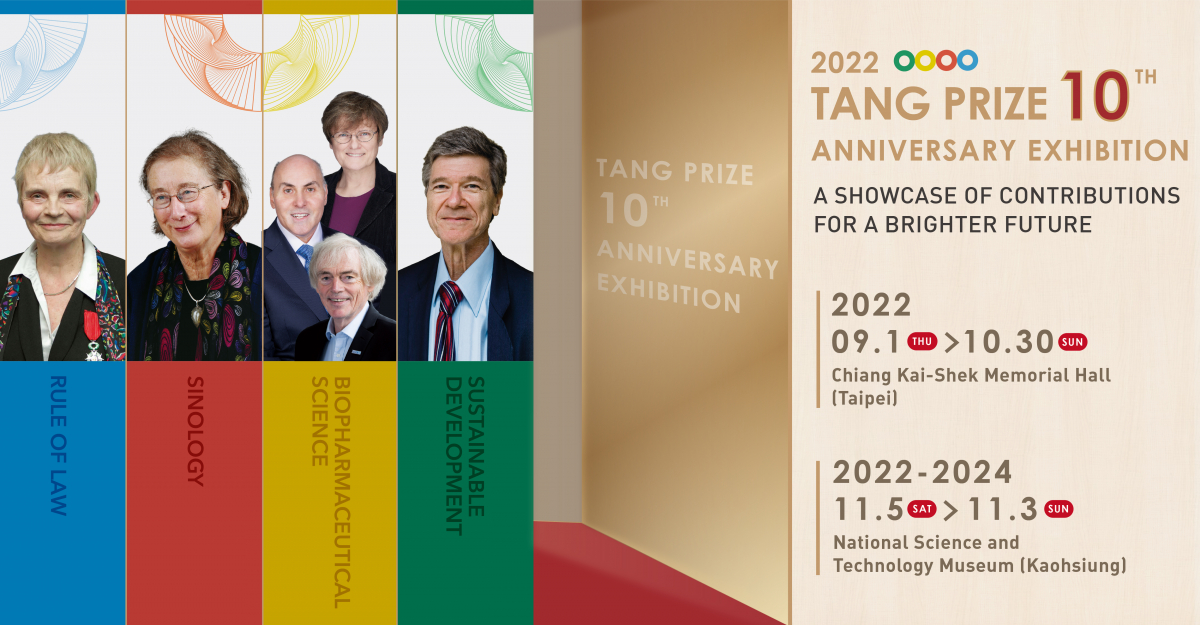
To celebrate the 10th anniversary of Tang Prize, Tang Prize Foundation will hold " Tang Prize 10th Anniversary Exhibition" at Chiang Kai- Shek Memorial Hall in Taipei from September 1st to October 30th. The opening press conference will be held in the auditorium on September 1st. We sincerely invite everyone to come and share the glory of Tang Prize winners!
-----------------
This exhibition presents the contributions of Tang Prize winners to the public in an easy-to-understand way, and an interactive area that combines education with entertainment is designed for the whole family. Please feel free to visit the exhibition. https://youtu.be/VND79fd-izg
|
|
Last Updated on Friday, 26 August 2022 17:20 |
|
2022 Tang Prize Laureates--Six Voices that Provide Stability to the World |
|
|
|
|
Written by Administrator
|
|
Thursday, 23 June 2022 14:51 |
|
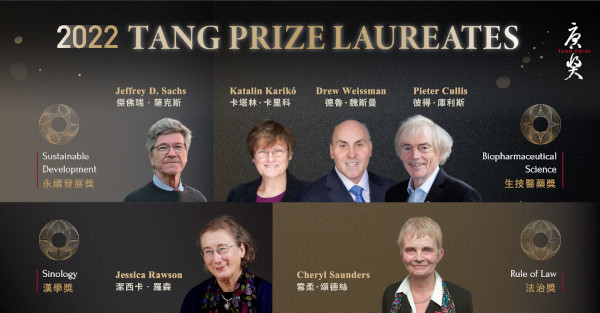
Since the outbreak of COVID-19, more than 530 million inflections have been reported globally. With the virus still raging in many countries, the world is suffering from supply chain disruptions and decade-high inflation, which has been exacerbated by the rising food and fuel prices due to regional conflicts. Political tensions in the international community also mean no one country can be immune to the adversities mentioned above. In addition, the European Union’s Carbon Border Adjustment Mechanism is scheduled to be implemented with a transitional period in 2023, and it is expected that the United States, the United Kingdom, and Japan will follow suit soon. How would different governments react to the pressure of achieving net zero by 2050? Six laureates of the 2022 Tang Prize, newly introduced to the public in four press conferences taking place from June 18 to 21, have all shown selfless devotion to the advancement of human civilization and the improvement of the wellbeing of humanity. It is, thus, our sincere belief that their outstanding contributions to their individual disciplines and the insightful views they have expressed can bring stability and new opportunities to a world at a critical juncture at the moment.
In 2022, the Tang Prize in Sustainable Development was awarded to Jeffrey Sachs. A world renowned professor of economics who served as Special Advisor to three UN Secretaries-General, Professor Sachs is currently Director of the Center for Sustainable Development at Columbia University and President of the UN Sustainable Development Solutions Network (SDSN). He has made important contribution to the establishment and promotion of the UN Sustainable Development Goals (SDGs) and was recognized by the Selection Committee for “leading transdisciplinary sustainability science and creating the multilateral movement for its applications from village to nation and to the world.”
As an eminent economist of international distinction, Professor Sachs has conducted ground-breaking research in many areas, such as debt crises, hyperinflations, transition from central planning to market economies, and eradication of extreme poverty. Moreover, when addressing complex issues related to global sustainable development, he combined the fields of global economics, public health, equity and sustainability to pioneer a multidisciplinary approach to solving these problems, transforming sustainable development into an integrated field of study and practice. His outstanding scholarship, advice to world leaders, educational innovation, and efforts in the global advocacy and realization of sustainable development have proven him to be a true leader of great vision, of profound influence, and imbued with deep humanistic concern.
The Prize in Biopharmaceutical Science went to three scientists who played a critical role in the development of SARS-CoV2 mRNA vaccines: Katalin Kariko, Drew Weissman, and Pieter Cullis, “for the discovery of key vaccinology concepts and approaches, leading to successful development mRNA-based COVID-19 vaccine,” according to the Selection Committee’s citation. The breakthrough discoveries of these three laureates and the ingenious approaches they pioneered are the key to the rapid and successful development of vaccines against SARS-CoV-2. While Dr. Kariko and Dr. Weissman found a way to reduce the immunogenicity of mRNA, Prof. Cullis is credited with designing lipid nanoparticles for the delivery of mRNA vaccines. As a result of their efforts, millions of lives have been saved.
The new platform developed by these three scientists is a nucleoside-modified mRNA based vaccine that can evade the immune system, thus preventing the severe inflammation which occurs when in vitro-transcribed mRNA is recognized by immune cells. These mRNA molecules are encapsulated in lipid nanoparticles and delivered effectively into the cells. They then instruct the cell’s machinery to produce harmless pieces of spike protein found on the surface of the coronavirus and initiate a series adaptive immune response, such as triggering B cells to produce antibodies and training T cells to attack infected cells. These techniques not only revolutionized vaccinology but also signaled a paradigm shift in protein therapy. They represent the advent of a new era of RNA-based therapies. Moreover, they can be applied to tackle a variety of diseases, such as to the development of vaccines against other viruses, of tailored-made vaccines against cancer, of vaccines against HIV, or even of vaccines against allergic diseases.
The Prize in Sinology is awarded to Professor Dame Jessica Rawson, “for her gift and mastery of the craft of the visible to read the art and artifacts of Chinese civilization. By giving voice to the ancient world of objects, she has taught generations how to see when they look at things, and her acuity and vast visual learning have given new insight into the world of the lineages, transformations, and migrations of mute things.”
Her contributions show that, besides the written word, there is another talent, another craft, which, by reading the art and artifacts of the world, allows us to interpret and understand distant and ancient societies, with their beliefs and interactions. Professor Rawson has taken this approach in her study of Chinese bronzes and jades, ancient Chinese tombs, and most especially in the exchanges between the peoples of the central China and their neighbors, for example in horse harness, revealing the role of horse-trading with the steppe and along the Silk Road. She has shown that the many regions of Eurasia had their own traditions, their own visual systems, in which artifacts, their materials, their forms and their multiple ornaments were combined in set ways. In reading these combinations, she has been able to follow and illuminate the transmission of visual systems between Eurasia and China. Most recently, Professor Rawson’s work on the introduction of horses from Mongolia to China has led to new ideas on the origins of the Silk Road. In short, her original and trailblazing achievements in the archaeology of China and Inner Asia have revolutionized and broadened our understanding of early contact and exchange between the East and the West.
Professor Cheryl Saunders won the Prize in Rule of Law, for “her pioneering contributions to comparative constitutional law, and in particular her work on constitutions-building in the Asia-Pacific region.” In the citation, the Selection Committee paid tribute to her working methods, noting that she applies “her scholarship to inspire and advise constitution-making exercises, often under challenging circumstances,” and that she “consistently broadens the boundaries of comparative constitutional law scholarship through active engagement, dialogue and collaboration with scholars and political actors at home and abroad.”
As the first woman to be appointed a law professor at the University of Melbourne, Professor Saunders has been made an officer of the Order Australia, awarded the Australian Centenary Medal, and Légion d'Honneur of France, and granted an honorary doctorate from the National University of Cordoba. Currently Laureate Professor Emeritus at the University of Melbourne, Professor Saunders is not only a pioneer in comparative constitutional studies but also an academic practitioner. She places special emphasis on an inclusive approach to comparative constitutional studies, advocating for incorporating constitutional experience from all over the world into our thinking, which broadens the vision of studies of comparative constitutional law beyond focusing on developments in Europe and North America. Prof. Saunders work is characterized by collaboration with networks of experts and scholars in the Asia-Pacific and elsewhere, bringing community-based talents along the road in countries such as Fiji, East Timor, Myanmar, Sri Lanka, Nepal, the Philippines and Bhutan. Through applied knowledge and experience, Professor Saunders has learnt the importance of prioritizing both national ownership and fit with local context, in the interests of effective implementation. To make comparative insights useful, she works with local scholars and practitioners to organize workshops and forums, to identify priorities, issues and options from local perspective. She has made considerable contributions to countries in the Asia-Pacific and elsewhere in terms of assistance with constitution-building and inspired people who want to change society through constitutional reform.
About the Tang Prize
Since the advent of globalization, mankind has been able to enjoy the convenience brought forth by the advancement of human civilization and science. Yet a multitude of challenges, such as climate change, the emergence of new infectious diseases, wealth gap, and moral degradation, have surfaced along the way. Against this backdrop, Dr. Samuel Yin established the Tang Prize in December 2012. It consists of four award categories, namely Sustainable Development, Biopharmaceutical Science, Sinology, and Rule of Law. Every other year, four independent and professional selection committees, comprising many internationally renowned experts, scholars, and Nobel winners, choose as Tang Prize laureates people who have influenced and made substantive contributions to the world, regardless of ethnicity, nationality or gender. A cash prize of NT$50 million (approx. US$1.7 million) is allocated to each category, with NT$10 million (approx. US$ 0.35 million) of it being a research grant intended to encourage professionals in every field to examine mankind’s most urgent needs in the 21st century, and become leading forces in the development of human society through their outstanding research outcomes and active civic engagement.
|
|
Advancing Constitution-Building in the Asia-Pacific, Australian Law Scholar Wins 2022 Tang Prize in Rule of Law |
|
|
|
|
Written by Administrator
|
|
Thursday, 23 June 2022 14:46 |
|
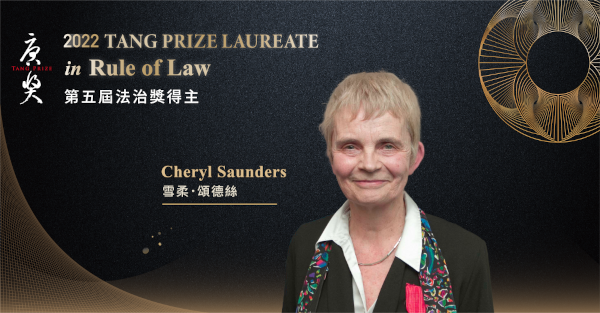
2022 Tang Prize in Rule of Law is awarded to Prof. Cheryl Saunders to recognize “her pioneering contributions to comparative constitutional law, and in particular her work on constitution-building in the Asia-Pacific region”. In the citation, the Selection Committee paid tribute to her working methods, noting that she applies “her scholarship to inspire and advise constitution-making exercises, often under challenging circumstances”, and that she “consistently broadens the boundaries of comparative constitutional law scholarship through active engagement, dialogue and collaboration with scholars and political actors at home and abroad.”
Prof. Saunders was born in today’s Quetta, Pakistan, and settled in Australia when she was five years old. From a university student to a university professor, the progression of her life has always been closely associated with the University of Melbourne, where she become the first woman to be appointed a law professor and where she founded the Centre for Comparative Constitutional Studies in 1988. She is also former associate dean of the Melbourne Law Masters and former president of the International Association of Constitutional Law. An elected fellow of the Academy of Social Sciences in Australia and the British Academy, Prof. Saunders has been made an officer of the Order of Australia, awarded the Australian Centenary Medal and Légion d'Honneur of France, and granted an honorary doctorate from the National University of Cordoba. Currently, she is Laureate Professor Emeritus at the University of Melbourne.
Prof. Saunders is not only a pioneer in comparative constitutional studies but also an academic practitioner. Always taking great interest in constitutional law, she was early to develop a passion for the emerging but often undervalued discipline of comparative constitutional law. In 1988, she set up the Centre for Comparative Constitutional Studies to increase the international reach of this discipline, an effort that, when she reminisced about it, allowed her to begin “to realize how fascinating it (comparative constitutional law) was and how comparative work could shed light on way that we all do things, including in Australia.” Prof. Saunders places special emphasis on an inclusive approach to comparative constitutional studies, advocating for incorporating constitutional experience from all over the world into our thinking, which broadens the vision of studies of comparative constitutional law beyond focusing on developments in Europe and North America.
Her commitment to comparative constitutional law became the impetus behind her engagement in the making and implementation of constitutional change in the Asia-Pacific region and in other parts of the world. These activities in turn broadened her understanding of constitutional experience around the world and gave her insights into how comparative constitutional knowledge can most usefully be shared. From the 1990s onwards, she was involved in constitution building and other related constitutional discussions in a wide range of regional countries including Fiji, East Timor, Myanmar, Sri Lanka, Nepal, the Philippines and Bhutan. In some of these cases, constitution-building was taking place in the most challenging of circumstances, involving transition to democracy from authoritarian rule. In all of them, the issues raised were difficult and important for the wellbeing of the people of the country concerned.
Some of Prof. Saunders engagement in practical assistance of this kind has taken place under the auspices of national or international agencies of various kinds, including International IDEA, with which she has worked for many years, in many parts of the world, including the Middle East and North Africa. In recent years, with colleagues at Melbourne Law School, she has founded the Constitution Transformation Network (ConTransNet) to explore both theoretically and practically the role of constitutions in the current age of global interaction and how constitutions can be made and changed in ways that support their practical effect.
Prof. Saunders’ work is characterized by collaboration with networks of experts and scholars in the Asia-Pacific region and elsewhere, bringing community-based talents along the road. Constitution-building can be a tortuous journey in which progress is met with setbacks. Through applied knowledge and experience, Prof. Saunders has learnt the importance of prioritizing both national ownership and fit with local context, in the interests of effective implementation. Prof. Saunders always shows full respect for the culture and customs of communities and grassroots decision-making. To make comparative insights useful, she prefers to work with local scholars and practitioners, in workshops and forums, to identify priorities, issues and options from a local perspective. She has made considerable contributions to countries in the Asia-Pacific and elsewhere in terms of assistance with constitution-related problems and has inspired people who want to change society through constitutional reform.
The Asia-Pacific is characterized by its ethnic diversity and large populations, as well as complex histories, cultures, and political systems. While often overlooked in the past, its significance to the rest of the world is only growing as the region increasingly becomes the center of the global economy and geopolitical strategy. From the outset of her long engagement with comparative constitutional law, Professor Saunders has explored how the concept of constitutionalism is put into practice globally and locally, and has sought to pinpoint the challenges facing the working of contemporary constitutional orders. In addition, Prof. Saunders carefully analyzes the formal constitutional changes recently taking place in countries in East and South East Asia, the Pacific island states and elsewhere, documenting the implementation of constitutions, the challenges they confront and the insights they offer in a region readily distinguishable from the West by its unique culture, history, and circumstances.
About the Tang Prize
Since the advent of globalization, mankind has been able to enjoy the convenience brought forth by the advancement of human civilization and science. Yet a multitude of challenges, such as climate change, the emergence of new infectious diseases, wealth gap, and moral degradation, have surfaced along the way. Against this backdrop, Dr. Samuel Yin established the Tang Prize in December 2012. It consists of four award categories, namely Sustainable Development, Biopharmaceutical Science, Sinology, and Rule of Law. Every other year, four independent and professional selection committees, comprising many internationally renowned experts, scholars, and Nobel winners, choose as Tang Prize laureates people who have influenced and made substantive contributions to the world, regardless of ethnicity, nationality or gender. A cash prize of NT$50 million (approx. US$1.7 million) is allocated to each category, with NT$10 million (approx. US$ 0.35 million) of it being a research grant intended to encourage professionals in every field to examine mankind’s most urgent needs in the 21st century, and become leading forces in the development of human society through their outstanding research outcomes and active civic engagement.
|
|
Giving Voice to Mute Objects, British Art Historian Wins 2022 Tang Prize in Sinology |
|
|
|
|
Written by Administrator
|
|
Thursday, 23 June 2022 14:33 |
|
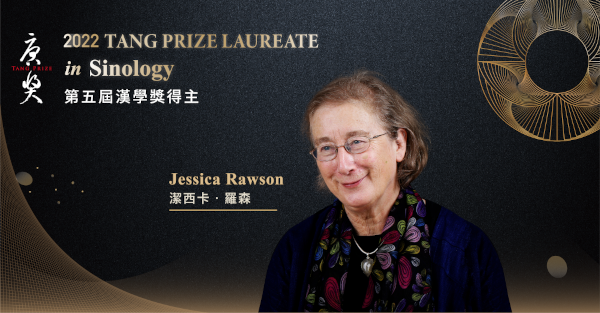
The 2022 Tang Prize in Sinology is awarded to Professor Dame Jessica Rawson, “for her gift and mastery of the craft of the visible to read the art and artifacts of Chinese civilization. By giving voice to the ancient world of objects, she has taught generations how to see when they look at things, and her acuity and vast visual learning have given new insight into the world of the lineages, transformations, and migrations of mute things.”
Her contributions show that, besides the written word, there is another talent, another craft, which, by reading the art and artifacts of the world, allows us to interpret and understand distant and ancient societies, with their beliefs and interactions. Professor Rawson has taken this approach in her study of Chinese bronzes and jades, and most especially in the exchanges between the peoples of the central China and their neighbors, for example in horse harness, revealing the role of horse-trading with the steppe and along the Silk Road. She has shown that the many regions of Eurasia had their own traditions, their own visual systems, in which artifacts, their materials, their forms, and their multiple ornaments were combined in set ways. In reading these combinations, she has, for example, been able to follow and illuminate the transmission of Western classical architectural ornament to Western Asia and then along the Silk Roads to China, where it was adapted for the great Buddhist caves. This exchange was the foundation of a whole new repertory of design in China. In due course this new repertory was taken westwards again by the Mongols. As such visual systems are taken over in new contexts, they leave behind their former messages and gain thereby new associations.
Professor Rawson has also made extensive studies of ancient Chinese tombs which provided a complete afterlife world for the dead. Shang and Zhou period vertical shaft tombs were accompanied by bronze and jade artifacts, which not only gave the dead objects for ritual and status, but also weapons and carriages for war. Many major changes occurred with the Qin. The elaborate burial of the First Emperor, Qin Shi Huangdi, not only contained an army of terracotta warriors, but also stables, carriages, court officials, wrestlers, concubines, and images of the heavenly bodies, making the tomb not an image of a universe, but actually creating this universe for the afterlife of its occupant. In this research, Professor Rawson has drawn our attention to the very different approach in ancient China to the notion of images, where the terracotta warriors were in the Emperor’s eyes a complete army for warfare in the afterlife.
Professor Rawson’s contributions to the field of Sinology extend beyond original and trailblazing scholarly contributions. Her tireless efforts to develop and promote exchange in the field of Sinology as well as help the public better understand Chinese civilization are equally laudable. Starting out as a museum curator, she has long been both a practitioner and an academic, and the impact of her curated exhibitions has long been evident to all. Even after moving to the University of Oxford after 28 years of service at the British Museum, she continued to present the diversity of Chinese culture to the public through enlightening exhibitions including China: The Three Emperors, 1662-1795. Held at the Royal Academy of Arts from 2005 to 2006, this exhibition took us back to imperial China, to the reigns of three of the most powerful Qing emperors, to explore the artistic and cultural riches of this period and their vivid connotations.
Born in London and educated at the University of Cambridge and the University of London, Professor Rawson is currently Professor of Chinese Art and Archeology at the University of Oxford, and previously served as the first female Warden of Merton College from 1994 to 2010 and Pro-Vice-Chancellor from 2006 to 2010. Professor Rawson has expanded the study of Chinese culture and civilization both on and off campus. From 2011 to 2016, funded by the Leverhulme Trust, she collaborated with Chinese scholars and led a major transnational research project titled, “China and Inner Asia: Cultural Exchange that Transformed China (1000-200 BC)” to investigate newly excavated sites and artifacts to study the interaction of northern China with the Mongolian and South Siberian Steppe. On campus, she has facilitated academic exchanges between scholars from around the world and nurtured students of various cultural backgrounds, many of whom have become leading scholars in the field of Chinese art and archaeology. Of particular note is her contribution to furthering Sinological research at Oxford. She bid and received a ten-year grant to support the development of the study of contemporary China, which enabled the appointment of two senior and two junior academic positions, leading to the expansion of posts in the study of China. This was one of the moves that contributed to the foundation of the Oxford University China Centre in May 2008.
When it comes to recognition, Professor Rawson’s career has been marked by honors. She is a Fellow of the British Academy and was made a Dame Commander of the Order of the British Empire in 2002 for her contribution to Oriental Studies. In 2012, she was elected to the American Academy of Arts and Sciences as an International Honorary Member and received the 2017 Charles Lang Freer Medal for her lifetime work in Chinese art and archaeology. And now, we award the 2022 Tang Prize in Sinology to Professor Rawson for her remarkable contributions that created a new dimension in the study of Chinese art and archaeology, deepening our understanding of the growth of Chinese civilization.
About the Tang Prize
Since the advent of globalization, mankind has been able to enjoy the convenience brought forth by the advancement of human civilization and science. Yet a multitude of challenges, such as climate change, the emergence of new infectious diseases, wealth gap, and moral degradation, have surfaced along the way. Against this backdrop, Dr. Samuel Yin established the Tang Prize in December 2012. It consists of four award categories, namely Sustainable Development, Biopharmaceutical Science, Sinology, and Rule of Law. Every other year, four independent and professional selection committees, comprising many internationally renowned experts, scholars, and Nobel winners, choose as Tang Prize laureates people who have influenced and made substantive contributions to the world, regardless of ethnicity, nationality or gender. A cash prize of NT$50 million (approx. US$1.7 million) is allocated to each category, with NT$10 million (approx. US$ 0.35 million) of it being a research grant intended to encourage professionals in every field to examine mankind’s most urgent needs in the 21st century, and become leading forces in the development of human society through their outstanding research outcomes and active civic engagement.
|
|
|
|
|
|
|
Page 5 of 14 |

分會會址:台北市大安區辛亥路三段188號7樓706室;電話:+886-2-81619999 分機7266;
傳真:+886-2-81619998;E-mail:tciae.org@gmail.com
Copyright © 2010 TCIAE. All Right Reserved.
|
|
Numbers Guests on Line
We have 38 guests online
Taiwan-Russia cooperation platform
Russian Learning Corner
|